 UCAS Oxbridge & medicine
 DAAD EPOS
 Fulbright Scholar
 Stipendium Hungaricum
 Sweden autumn 2027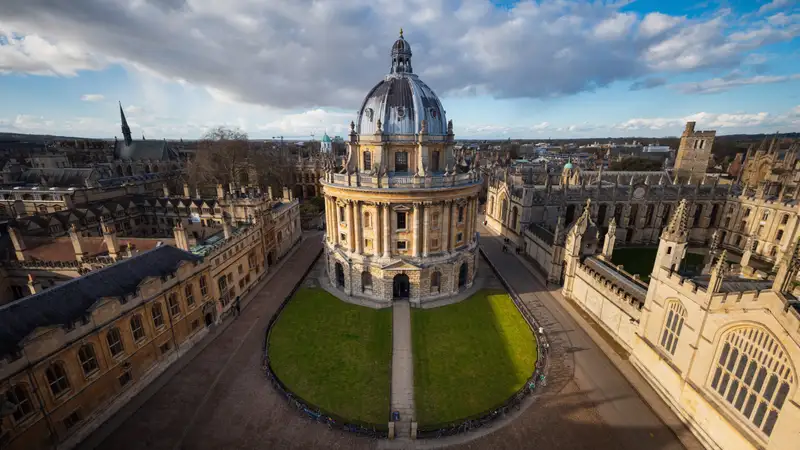
Clarendon Scholarship At Oxford: The Complete Guide For Pakistani Applicants
Oxford’s largest graduate scholarship has no separate application: you are considered automatically if you apply by the right deadline. How Clarendon selection really works, what departments look for, and how to build an Oxford application that ranks at the top.
 Reading time20 min
 Sections35
 Updated9 October 2026
 Sources4 official
Photo: Julian Herzog, CC BY 4.0, via Wikimedia Commons
The 60-second version
Key takeaways · then go as deep as you like- 1Clarendon is the University of Oxford’s flagship graduate scholarship scheme, offering over 200 new scholarships each year.
- 2There is no separate application: if you apply for an eligible master’s or DPhil by the December or January deadline for your course, you are considered automatically.
- 3Selection is based on academic excellence and potential, judged first by your department, which ranks applicants for funding.
- 4Clarendon covers course fees in full and provides a generous grant for living costs.
- 5The real work is your Oxford application: statement of purpose, research proposal (for research degrees), references and grades.
- 6Pakistani applicants with top grades and a precise fit to their course compete well; there is no nationality quota.
200+
New scholarships a year
Automatic
No separate form
Dec / Jan
Course deadlines that count
Fees + living
What it covers

Part 1 of 6
The basics
01Clarendon In One Minute
The Clarendon Fund is the University of Oxford’s largest graduate scholarship scheme. It was set up in 2001 and funds outstanding graduate students from around the world. Over 200 new Clarendon Scholarships are awarded every year, alongside many partnership awards co-funded with colleges, departments and donors.
The defining feature of Clarendon is that there is no separate application. If you apply to an eligible Oxford master’s or DPhil course by the relevant December or January deadline, you are automatically considered. Your Oxford application is your Clarendon application.
The short version
Clarendon = Oxford’s flagship graduate scholarship
- over 200 new awards a year
- no separate form: apply to Oxford by the Dec/Jan deadline
- judged on academic excellence and potential.
02How Competitive Is It?
Oxford receives tens of thousands of graduate applications each year, and only a fraction of admitted students receive full scholarships. Clarendon’s 200+ new awards are spread across every subject, so in practice each department has a small number of Clarendon nominations. You are competing with the strongest applicants to your own course.
200+
New Clarendon awards a year
All subjects
Every graduate field eligible
All nationalities
Including Pakistan
2001
Fund established
There is no published success rate. A practical rule: if your application is among the very top of your department’s admitted applicants, you have a real chance. That is why course choice and application quality matter so much.
03What Clarendon Covers
- University and college course fees, in full.
- A grant for living costs, in line with Oxford’s standard rates for funded graduate students.
- Funding for the full fee-liable period of your course (for example three to four years for a DPhil).
- Membership of the Clarendon community, with events and an active scholars’ association.
Some Clarendon awards are partnership scholarships co-funded with a college or department. They work the same way for you, but you may be asked to join a particular college.

Part 2 of 6
Are you eligible?
04Who Is Eligible
- 1Applicants of any nationality, including Pakistan.
- 2Applying for a new full-time or part-time master’s or DPhil course at Oxford (most courses are eligible; check yours).
- 3Submitting a complete application by the relevant December or January deadline for the course.
- 4Not already studying for a DPhil at Oxford (with limited exceptions).

Watch out: Applying after the January deadline, even if the course still accepts applications, means you are not considered for Clarendon. Missing this is the most common reason strong Pakistani applicants lose out.
05How Clarendon Selection Really Works
Understanding the process tells you where to put your effort:
- 1
You apply to Oxford
By the December or January deadline for your course.
- 2
Department assesses
Academics read and rank applicants for admission and for funding.
- 3
Departments nominate
The strongest applicants are nominated for Clarendon and other scholarships.
- 4
Clarendon decides
Awards are made from nominated candidates across the university.
- 5
You are notified
Usually in the spring, often with or after your admission offer.
So Clarendon is decided by how highly your department rates you. There is no Clarendon essay to write; there is your statement of purpose, your proposal and your references.
06Oxford’s Funding Rounds, Explained
Oxford graduate admissions run through the year, but funding is concentrated around the early deadlines. Courses typically have a December deadline, a January deadline, or both, plus later deadlines that do not include scholarship consideration.
| Deadline type | Clarendon consideration? | What it means for you |
|---|---|---|
| December (where offered) | Yes | Earliest consideration; best for competitive courses |
| January | Yes | The main funding deadline for most courses |
| March or later | No | Admission only; no Clarendon or most other scholarships |
Departments assess funding applicants together after the January deadline, then nominate for Clarendon and other awards. Decisions often arrive between February and April, sometimes after your admission offer.
07How Departments Rank For Funding
Each department uses its published selection criteria to assess applicants, then ranks those it wants to admit. Funding nominations go to the top of that ranking. Common assessment points include:
- Academic record: degree class or CGPA, rank, and performance in relevant courses.
- The statement of purpose: understanding of the subject, motivation and fit.
- Research proposal and written work, where required.
- References: comparative judgements from academics.
- Interview performance, where the course interviews.
Everything that moves you up that ranking moves you towards Clarendon. There is no extra Clarendon essay to strengthen your case; there is only a stronger Oxford application.

Part 3 of 6
Building your profile
08The Typical Successful Applicant
Typical Clarendon scholar (TeamOnline observation)
- Grades
- First-class equivalent; top of their cohort
- Research
- Thesis or publications for DPhil; strong projects for master’s
- Course fit
- Precise interest matching Oxford faculty
- Statement
- Specific, scholarly, well-argued
- Proposal (DPhil)
- Focused, feasible, original
- References
- Academics who rank them among the very best
- English
- Comfortably above Oxford’s higher-level requirement
- Timing
- Applied early, well before the deadline
An observation, not an official profile.
Clarendon is closer to a pure academic scholarship than Rhodes, Gates or Chevening. Leadership and service help your overall profile, but departments rank on academic excellence and potential.
09Clarendon Partnership Awards
Many Clarendon awards are partnership scholarships, co-funded with a college, department or donor and often carrying a named title. For you, they work the same way: same automatic consideration, same coverage. The differences are practical: you may be placed in the partner college, and some partnership awards are limited to particular subjects or regions.
You do not choose a partnership award; the university matches nominated candidates to available awards. If you receive one, you are a Clarendon Scholar with full access to the Clarendon community.
10How An Oxford DPhil Works
If you are applying for a DPhil (Oxford’s PhD), it helps to understand the structure, because your proposal should fit it:
- 1
Year 1
Probationer Research Student
Training, refining your project, early research.
- 2
End of year 1 or early year 2
Transfer of Status
An assessment that you are ready for full DPhil research.
- 3
Year 3
Confirmation of Status
Progress review before final writing.
- 4
Years 3–4
Thesis and viva
Submission and oral examination.
Clarendon funds the fee-liable period of the DPhil, typically three to four years. A proposal that shows a realistic path through these stages reads as feasible.
11Choosing The Right Oxford Course
Oxford has hundreds of graduate courses, and the funding competition happens inside each one. Choose carefully:
- 1Match your background: a course that builds on your degree lets your grades and research count fully.
- 2Read the course’s selection criteria: Oxford publishes what each course assesses.
- 3Look at faculty research, especially for DPhils; name potential supervisors where the form allows.
- 4Check entry requirements, including English at the higher or standard level.
- 5Note the deadline: many courses have December and January deadlines; aim for the earlier one where possible.

Counsellor’s tip: Applying by the December deadline where available spreads your risk: some departments make funding decisions in rounds, and earlier applicants are considered in every round.
12Oxford Courses Pakistani Applicants Often Choose
| Field | Examples | Strong if you have… |
|---|---|---|
| Economics and development | MPhil Economics, MSc Economics for Development, MPhil Development Studies | Strong quantitative training and research interest in development |
| Public policy | Master of Public Policy (Blavatnik School) | Public-sector or policy experience and leadership |
| Computer science and engineering | DPhil in Computer Science or Engineering Science | Research projects or publications |
| Global health and medicine | MSc Global Health Science, MSc in International Health and Tropical Medicine, DPhil in Clinical Medicine | Medical or public health background |
| Law | BCL, MJur, MSc Law and Finance | An outstanding law degree |
| Humanities and area studies | MSt/MPhil in History, Oriental Studies, Modern South Asian Studies | Research interests and strong writing |
Where a course has a December deadline, applying then gives you the earliest funding consideration.
 Want a counsellor to check your plan?Free, and we reply within one working day.
13English Language Requirements
Oxford courses set English requirements at a standard or higher level. Many Clarendon-competitive courses require the higher level, typically IELTS 7.5 overall with at least 7.0 in each component. Pakistani applicants with English-medium degrees may still need a test; check each course’s rules and waivers.
Counsellor’s tip: Take IELTS by October so a retake is possible before the January deadline if needed. An offer conditional on English is fine, but meeting it early removes risk.

Part 4 of 6
The application
14The Statement Of Purpose
Oxford statements are academic documents. Assessors look for evidence of motivation for the course, understanding of the subject, ability to think and write analytically, and commitment to the area of study.
Your academic interest
The specific questions or areas you want to pursue, and why.
Your preparation
Courses, research, methods and reading that prepare you.
Why this course
Its structure, options, faculty and resources.
Your trajectory
Where the course leads you academically or professionally.
Example
- Weak“Oxford is one of the best universities in the world and I am passionate about economics.”
- Stronger“My undergraduate thesis estimated the effect of Pakistan’s 2019 gas-tariff change on small textile firms and left me with a question I could not answer with cross-sectional data: how do firms substitute energy sources over time? The MPhil’s second-year thesis and its applied microeconometrics options would let me build the panel data methods I need.”
Watch out: Stay within the word limit. Oxford is strict, and over-long statements can be penalised.
15The Research Proposal (For DPhils And Research Master’s)
| Section | What strong looks like |
|---|---|
| Question | One precise, original research question |
| Context | What is known and the gap you address |
| Methods | How you will answer it, and why these methods |
| Sources and data | Archives, datasets, fieldwork or lab work, and access |
| Feasibility | Why it can be done in the time available |
| Fit | Why this department and potential supervisors |
Read our guide on writing a PhD research proposal. For Oxford, the proposal is also evidence of how you write and think, so make it clear and well structured.
16Written Work
Many Oxford courses ask for written work, often an academic essay or a chapter of a thesis, within a word limit. It is assessed on how well you argue, use evidence and write.
- Choose your best analytical piece, ideally related to the course.
- Edit it carefully to the word limit; you can usually excerpt longer work.
- Make sure it is your own work and in English.
- If the course allows, add a short note on context.
17A Sample Statement Of Purpose Excerpt
Excerpt (fictional applicant)
My interest in energy economics began with a practical problem. During my final year at university, my family’s weaving workshop in Faisalabad switched from gas to grid electricity and back three times as tariffs changed. Each switch cost weeks of production. My undergraduate thesis, using the Census of Manufacturing Industries, estimated that small textile firms responded to the 2019 tariff change by cutting operating hours rather than investing in efficiency (the full results are in my written work).
The thesis left me with a question that cross-sectional data cannot answer: how do small firms substitute between energy sources over time, and which policies make efficient investment more likely? The MPhil in Economics would give me the panel-data and structural methods to answer it, and the second-year thesis would let me work with Professor X’s group on firm-level energy demand in emerging economies.
After the MPhil, I intend to continue to doctoral research and ultimately to contribute evidence to Pakistan’s energy policy, where tariff decisions are still made with little information about how firms actually respond.
The excerpt shows an academic question growing from experience, evidence of prior research, precise fit to the course, and a credible trajectory. That is what moves an applicant up a department’s funding ranking.
18References
Oxford usually asks for three references, mostly academic. For Clarendon, they are among the most important documents in your file because departments rank applicants for funding partly on how referees compare them with others.
- 1Choose referees who know your academic work well and recently.
- 2Ask them to compare you with peers explicitly where they can.
- 3Give them your statement, proposal and CV, and remind them of your best work in their course.
- 4Make sure they submit by the deadline; late references can delay assessment.
19Choosing Referees In Pakistan
Pakistani applicants often ask whether to choose the head of department or the professor who knows them best. For Oxford, choose knowledge over seniority:
| Referee | Usually better? | Why |
|---|---|---|
| Thesis supervisor | Yes | Knows your research ability in detail |
| Professor who taught you in a core course and knows your work | Yes | Can compare you with classmates |
| Head of department who barely knows you | Usually no | Letters become generic |
| Employer (for professional courses like the MPP) | Sometimes | If the course values professional experience |
Ask each referee to include a comparative statement where honest (for example “top 1 percent of students I have taught”). Departments rely on these comparisons when ranking for funding.
20Your Oxford CV
- Two pages at most, education first with grades and rank.
- Research experience, publications and conference presentations next.
- Relevant work experience, especially for professional courses.
- Awards and scholarships, briefly.
- Skills relevant to the course: languages, software, lab methods.
Remove school-level achievements unless exceptional, and avoid photos, personal details beyond contact information, and long objective statements.
21Common Mistakes
| Mistake | Effect | Fix |
|---|---|---|
| Applying after the January deadline | Not considered for Clarendon | Apply by December or January |
| Course that doesn’t fit your degree | Lower ranking | Choose a course your record supports |
| Generic statement | Assessors cannot see your thinking | Specific questions and preparation |
| Over-broad proposal | Looks infeasible | Narrow and focus |
| Weak references | Lower funding ranking | Brief referees; choose those who know you |
Part 5 of 6
After you apply
22Timeline For Oxford Funding
- 1
Summer before
Prepare
Choose courses; IELTS if needed; draft statements.
- 2
September
Applications open
Oxford graduate applications open for most courses.
- 3
November
Supervisors and referees
Contact potential supervisors (DPhil); brief referees.
- 4
December–January
Submit
By the course deadline relevant for funding.
- 5
February–April
Decisions
Admission offers, then funding decisions in rounds.
- 6
Summer
Prepare
Visa, college and arrival.
23If You Receive An Offer Without Funding
Many strong Pakistani applicants receive an Oxford offer but no Clarendon or other full scholarship. Before deciding:
- 1Ask the department whether you remain under consideration for later funding rounds.
- 2Check college scholarships and external awards you can still apply for.
- 3Calculate the full cost: overseas fees plus living costs for the course length.
- 4Consider deferring only if the course allows it and you have a realistic funding plan.
- 5Compare with funded offers elsewhere; a funded place at another strong university may be the better choice.
Watch out: Oxford requires proof of funding for the whole course before you can enrol. Do not accept an unfunded place hoping funding will appear later.
24Colleges And Living In Oxford
Every Oxford graduate student is a member of a college. Your college provides accommodation options, dining, welfare support and a community; your department provides teaching and supervision. Some colleges are graduate-only, and many have large international graduate communities.
| Monthly item | Typical range |
|---|---|
| College or private accommodation | £800–£1,200 |
| Food | £250–£350 |
| Study, phone and personal | £100–£200 |
The Oxford University Pakistan Society and college common rooms are where many Pakistani students find their community in the first weeks.
Want a counsellor to check your plan?Free, and we reply within one working day.
25Interviews
Some Oxford courses interview shortlisted applicants, usually online. There is no separate Clarendon interview. If your course interviews, expect academic questions about your research, written work and the subject.
 Have an Oxford interview coming up? Practise with academic-style questions and feedback.

Part 6 of 6
Strategy
- 26Other Oxford Scholarships To Know
- 27Application Fees And Waivers
- 28Oxford Or Cambridge?
- 29Clarendon vs Gates vs Rhodes
- 30A Three-Year Plan For Oxford Funding
- 31Questions Pakistani Applicants Ask
- 32Three Composite Case Studies
- 33If Your Course Interviews: Question Bank
- 34Your Final 30 Days Before The Deadline
- 35How TeamOnline Helps
26Other Oxford Scholarships To Know
| Scholarship | For | How to apply |
|---|---|---|
| Rhodes | Young leaders from eligible constituencies, including Pakistan | Separate Rhodes application |
| Weidenfeld-Hoffmann | Future leaders from developing countries, on selected courses | Separate application alongside your Oxford application |
| Pershing Square | MBA with a one-year master’s | Separate application |
| College and departmental awards | Varies | Often automatic with the Oxford application |
| Reach Oxford (undergraduate) | Undergraduates from low-income countries | Via undergraduate admissions |
Applying to Oxford by the January deadline puts you in the running for most of these at once, which is why early application is so valuable.
27Application Fees And Waivers
Oxford charges an application fee for most graduate courses, per course. For Pakistani applicants this is a real cost, especially if you apply to more than one course. Oxford has offered fee waivers for applicants from certain low-income countries and for some outreach schemes; check the current graduate admissions fee-waiver page early, because waiver applications have their own deadlines.
28Oxford Or Cambridge?
| Question | Oxford (Clarendon) | Cambridge (Gates) |
|---|---|---|
| Separate scholarship application | No | Yes, a Gates section |
| What decides funding | Department ranking on academic merit | Department ranking, then Gates criteria including commitment to others |
| Deadline that matters | December or January for your course | December or January for your course |
| Can I apply to both? | Yes | Yes |
Many applicants apply to both in the same year. Tailor each application to each course; the strongest applications are clearly written for one specific programme.
29Clarendon vs Gates vs Rhodes
| Item | Clarendon | Gates Cambridge | Rhodes |
|---|---|---|---|
| University | Oxford | Cambridge | Oxford |
| Separate application | No | Gates section in Cambridge application | Yes |
| Age limits | None | None | Strict |
| Main emphasis | Academic excellence and potential | Excellence, commitment to others, leadership | Scholarship, character, leadership |
| Pakistan places | No quota | No quota | Two a year |
30A Three-Year Plan For Oxford Funding
- 1
Two years before
Build the record
Top grades, a strong thesis topic, research assistantships.
- 2
One year before
Focus
Choose courses; read faculty research; prepare written work.
- 3
Summer before
Draft
Statement of purpose, proposal and CV; IELTS.
- 4
Autumn
Refine and contact
Supervisor emails; referee briefings; multiple drafts.
- 5
December–January
Submit
By the funding deadline.
31Questions Pakistani Applicants Ask
| Question | Short answer |
|---|---|
| Is a 3.5 CGPA enough? | It depends on your university, rank and course; departments compare you with other strong applicants. |
| Do I need a master’s before a DPhil? | Often yes in practice for Pakistani applicants, though some departments admit directly from a strong bachelor’s. |
| Can I apply to two Oxford courses? | Yes, but each application is separate and needs its own fee and documents. |
| Is there an application fee? | Yes, Oxford charges a graduate application fee per course; check fee waiver schemes. |
| Will Clarendon tell me if I was nominated? | Usually you only hear if you are awarded. |
32Three Composite Case Studies
Composites based on the profiles we see, not real individuals:
Case 1: the economist
- BackgroundBS Economics (top 2%), research assistant at a university centre.
- CourseMPhil in Economics (December deadline).
- StrengthThesis using household survey data; referees ranked her the best student in five years.
- What moved her up the rankingwritten work showing econometric skill and a precise statement.
- Outcome typeStrong Clarendon candidate.
Case 2: the researcher
- BackgroundMS Computer Science, two conference papers on Urdu natural language processing.
- CourseDPhil in Computer Science.
- StrengthA focused proposal and a supervisor who had read it.
- What moved him upPublications plus a feasible, original proposal.
- Outcome typeStrong DPhil funding candidate.
Case 3: the wrong fit
- BackgroundBA LLB with good but not top grades, strong advocacy experience.
- CourseBCL.
- ChallengeAcademic record below the very top of a highly competitive course.
- Better strategyApply for Chevening or Commonwealth for an LLM elsewhere, or strengthen academic record first.
- LessonClarendon is academic-first; match the course to your record.
33If Your Course Interviews: Question Bank
| Question type | Example | How to prepare |
|---|---|---|
| Your research | Walk us through your proposal’s methods. | Know every choice and its alternatives |
| Your written work | What would you change in this essay now? | Re-read it critically |
| The field | Which recent paper changed your thinking? | Read recent work by the faculty |
| Feasibility | What if you cannot get this data? | Have a plan B |
| Motivation | Why Oxford rather than elsewhere? | Specific people, resources and approaches |
| Problem-solving | A technical or analytical question | Think aloud; accuracy matters less than reasoning |
34Your Final 30 Days Before The Deadline
- 1
Day 30
Drafts complete
Statement, proposal and written work in near-final form.
- 2
Day 25
Academic reader
Ask a lecturer to read the proposal critically.
- 3
Day 20
Referees
Confirm referees have everything they need.
- 4
Day 14
Documents
Transcripts, degree certificates, English test in the portal.
- 5
Day 7
Word limits and format
Check every limit; Oxford is strict.
- 6
Day 3
Submit
Do not wait for the last day; references cannot be added after the deadline in some courses.
35How TeamOnline Helps
Course strategy
Courses where your record ranks highly.
Statement and proposal
Academic writing that shows how you think.
Written work
Choosing and editing your best piece.
Referees
Briefing referees for funding-level references.
Interview practice
If your course interviews.
Visa and arrival
From CAS to college.
Aiming for Oxford with a Clarendon Scholarship? Start with an honest review of your profile.
 You’ve reached the end
The fastest next step: send us your profile and we’ll tell you honestly where you stand.
Sources
Figures come from these official and published sources. Profile notes are TeamOnline’s own observation.
Rules, deadlines and requirements change. Check the current requirements on official pages or with a counsellor before you apply.
Quick answers
Frequently Asked Questions
01How do I apply for the Clarendon Scholarship?
You do not apply separately. If you apply for an eligible Oxford graduate course by the December or January deadline for that course, you are automatically considered.
02How many Clarendon Scholarships are there?
Over 200 new Clarendon Scholarships are awarded each year across all subjects.
03Can Pakistani students get Clarendon?
Yes. Clarendon is open to applicants of all nationalities.
04What does Clarendon cover?
Course fees in full and a grant for living costs, for the fee-liable period of your course.
05Is there a Clarendon interview?
No separate interview; some courses interview applicants for admission.
06What if I apply after January?
You will not be considered for Clarendon, even if the course still accepts applications.
Keep reading
More Deep Dives
 Scholarship deep dive
Chevening Scholarship From Pakistan: The Complete Guide (Eligibility, Essays, Interview, Success Rates)
27 min read
 Scholarship deep dive
Fulbright Scholarship From Pakistan: The Complete Guide to USEFP Master’s and PhD Awards
27 min read
 Scholarship deep dive
Commonwealth Scholarships From Pakistan: The Complete Guide to Master’s and PhD Awards Through HEC
26 min read
Free consultation
Turn this guide into a plan for you.
30 minutes, no fee, no obligation. In our Lahore office or on WhatsApp video.
- ReplyWithin one working day
- Since2009
- Students2,500+ advised

Book your free session
We only use your number to reply to you.